


Cornell University is trying out Earth Source Heat for clean renewable geothermal energy
-
- Published on August 15th, 2022

Earth Source Heat (ESH) is Cornell’s version of a deep geothermal system that would use the Earth’s internal heat to warm the Ithaca campus without the use of fossil fuels. The project is a research collaboration across several academic departments along with campus facilities staff, and it is a major component of the university’s goal of achieving carbon neutrality by 2035. If viable, ESH could also become a scalable solution for renewable heating in New York and in cold-climate regions across the globe.

By Earth Source Heat
Cornell University
Why is Cornell exploring Earth Source Heat?
Cornell scientists believe that the project holds potential that leads to a scalable solution that could be deployed across New York state and in other cold-climate regions around the world. It is widely agreed that there is enough natural heat within the earth to sustain us indefinitely, and drilling technology advancements allow access to this heat. While similar projects have succeeded in areas with geothermal potential on or near the surface, deep, direct-use geothermal systems have never been attempted in areas with the geological conditions present in upstate New York.
Why is the Cornell University Borehole Observatory necessary?
While Cornell is driven by the need to reduce its fossil fuel footprint, the university is also keenly interested in understanding the impacts of technology choices. Accordingly, Cornell plans to drill a “test” or exploratory borehole that will provide a gating mechanism to ensure the safety and soundness of the project before moving forward with injection and production well pairs. This test borehole, or the Cornell University Borehole Observatory (CUBO), will allow Cornell to precisely understand the geologic conditions beneath Ithaca, allow the university to develop ongoing monitoring systems and help ensure that the methods used to extract heat from deep within the Earth do not create unacceptable risks or unintended impacts.
Cornell is committed to studying and addressing these issues in a thorough and transparent manner, developing best practices that will minimize risk and provide guidance for others who might implement this technology. If it is determined that the process could safely and effectively advance, the next step is to drill a demonstration well pair on the Ithaca campus. Eventually, the university would hope to begin a phased process to create a full-scale system capable of heating the entire Ithaca campus.
 Cornell University Borehole Observatory Location
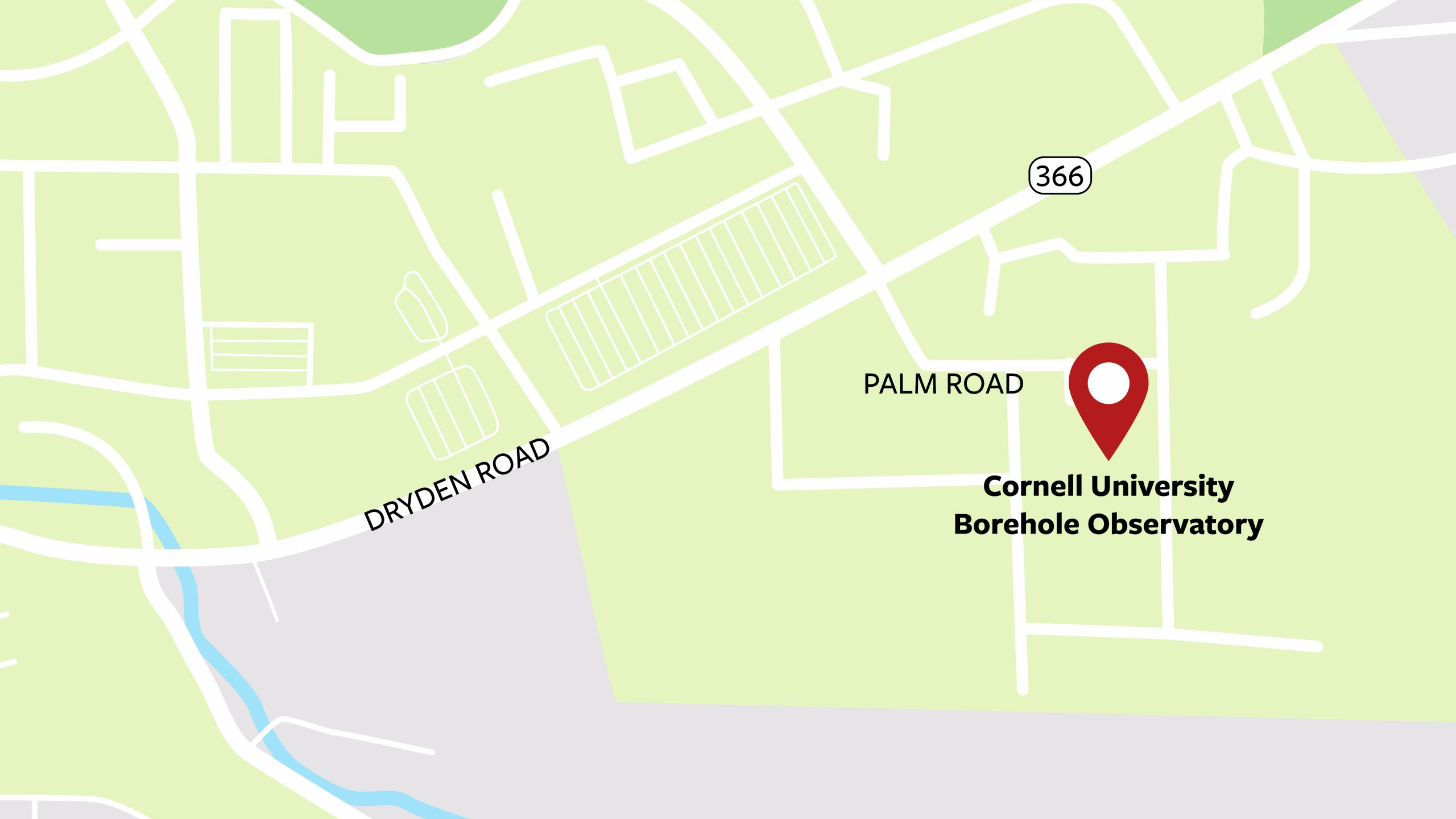
CUBO will be located on Cornell-owned property near Palm Road in the Town of Ithaca. Drilling at the site will not disrupt plants, trees or sensitive ecosystems because the site is already an open gravel pad (a former parking lot). Additionally, electricity and water services are already available at this site, which also eliminates the need for new disruptive construction to connect those resources.
Cornell University Borehole Observatory (CUBO) Project Updates
Cornell scientists are committed to studying and addressing these issues in a thorough and transparent manner, developing best practices that will minimize risk and provide guidance for others who might implement this technology.
The next phase in this exciting project is to drill an exploratory borehole, called the Cornell University Borehole Observatory (CUBO), which will allow scientists to further explore deep surface rock conditions and heat output.
Members of the project team provide regular updates during drilling for the Cornell University Borehole Observatory (CUBO). New videos are typically posted weekly on Thursdays.
View all project videos

Project status
During the past week we began drilling the final 8.5 inch section of the well, starting at 7,823 feet. As of August 8, we had reached a depth of 8,982 feet. Drill cuttings continue to be collected in containers on site, characterized by laboratory testing, and sent to a licensed landfill for safe disposal. Environmental monitoring programs are in place to measure groundwater and surface water quality and microseismicity.
During the coming week, we plan to complete the drilling to a depth of 10,000 feet. That will be followed by a program of geophysical, geological and hydrological measurements and testing to study the properties of the bedrock, fractures and fluids within potential geothermal development zones at depths between 8,000 and 10,000 feet.
CONTINUE EXPLORING
Ask a question or find out about visiting the CUBO site:
CONTACT US
(Originally appeared at the Cornell University Earth Source Heat website)


